The only public tour Judson Studios lists right now is set for Wednesday, December 9, 2026, from 10 a.m. to noon, and its registration page already says Sold Out. The two-hour visit starts at the studio's headquarters at 200 S. Avenue 66 in Garvanza. From there the group drives a few minutes to Judson's fusing studio at 143 Pasadena Ave. in South Pasadena. Tickets were $35 standard and $30 for students and seniors. An $80 option added a copy of JUDSON: Innovation in Stained Glass, the 2020 book from Angel City Press.
For anyone in Highland Park who missed out, the more useful fact is that the workshop's output has been on public view for about a hundred years. It hangs in a Frank Lloyd Wright house in Los Feliz, a Pasadena church, a Hollywood cemetery, a branch library on Olympic Boulevard and a Glendale chapel. Hollyhock House charges $12 for adult admission, and the churches open their doors for Sunday services.
The building on Avenue 66 is the first exhibit
Start with the headquarters, since it is in the neighborhood. William Lees Judson, an English artist, founded the studio in 1897 with his three sons, and it was based downtown at first. In 1901 he became dean of the University of Southern California's College of Fine Arts, which was then in Garvanza. The art school burned down, and the architecture firm Train and Williams designed the building that replaced it. The new building was finished in 1911. When Judson retired in 1920 and the school moved to the main USC campus, Judson Studios bought the building. In its early years it was also the headquarters of the Arroyo Guild of Fellow Craftsmen. Frank Lloyd Wright, Henry and Charles Greene and the tilemaker Ernest Batchelder came by often. The city lists it as Historic-Cultural Monument No. 62, and it is on the National Register.
In a 2024 profile, Etan Does LA traced the fire to a malfunctioning kiln in late 1910. It destroyed the whole campus down to the foundation. The same account says Train and Williams started sketching the replacement the day after the fire. The building looks unusual because its two wings meet at 110 degrees. One wing ran parallel to the old rail line and the other to Thorne Street, which met the tracks on a diagonal. The front walls are river rock and shingle. Concrete block sits along the first floor, red brick towers rise at the back, and a cylindrical turret is built into the structure. A cast-concrete frieze in a leaf pattern runs under the eaves. Many of the exterior decorations were made by art students in the 1910s.
The building still houses a working shop. The fusing work and glass painting happen in South Pasadena, at a facility Judson bought in 2015 for its largest commission yet. That was a 3,400-square-foot window for the Church of the Resurrection in Leawood, Kansas. On Avenue 66, glass is still cut by hand and leaded in the glazing room. Three mottos William Lees Judson painted on that room's walls are still there: "Only the best is worth while." "Art is only the beautiful way of doing things." "No steps backward." David Judson, the founder's great-great-grandson, is president, and the studio calls itself fifth-generation and family-owned.
That history explains why the public places below matter. Much of Judson's best-known work was made in this building during its first decade there, and the studio is often hired to restore pieces it made decades ago.
Hollyhock House has the most famous pieces
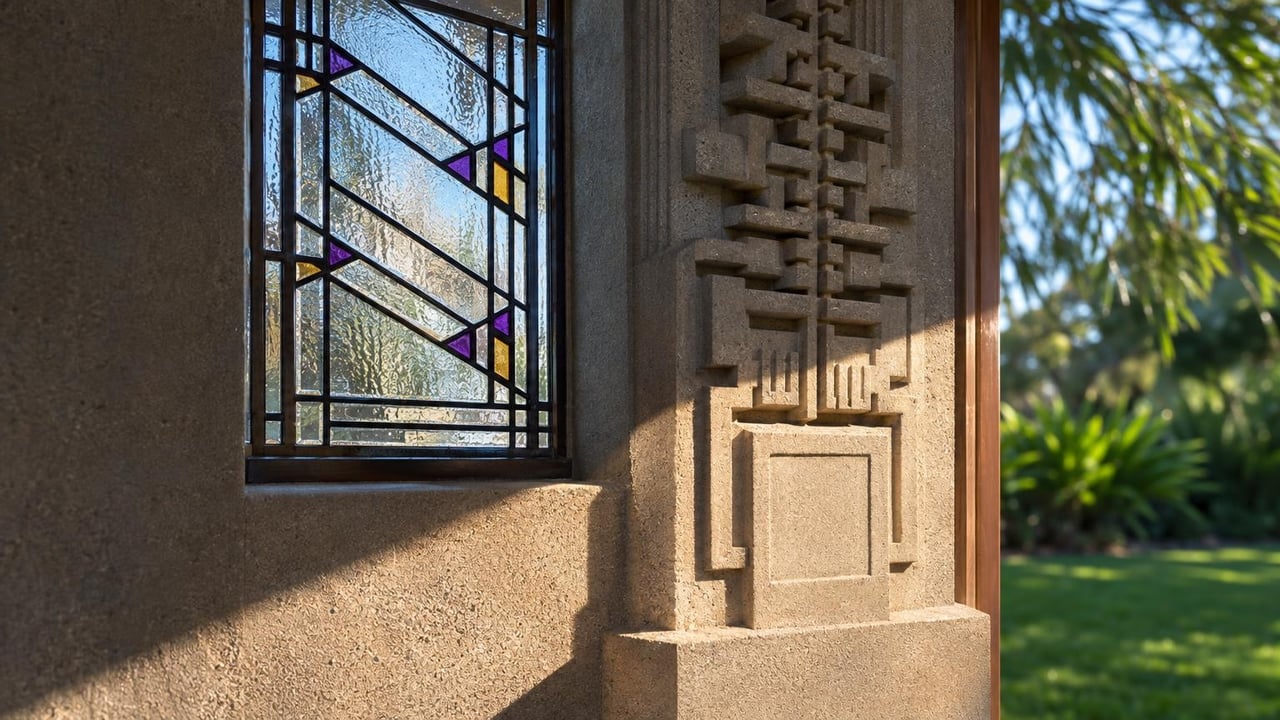
Judson's most famous public work is in Los Feliz. During the studio's first decade in Garvanza, it made and installed the geometric "light screens" at Frank Lloyd Wright's Hollyhock House and Ennis House. These were the last two homes for which Wright designed a complete stained-glass scheme. Hollyhock House was built between 1919 and 1921 and sits at 4800 Hollywood Boulevard.
Of all the places in this post, it is the easiest one to plan around. The Hollyhock House visit page lists self-guided admission Thursday through Saturday, 11 a.m. to 4 p.m., with last entry at 3:30. Tickets are $12 for adults and $6 for seniors 62 and up and students 18 and up with ID. Visitors under 18 get in free with a paying adult. Advance tickets are recommended. A docent-led exterior tour is also offered. It lasts about 20 minutes, takes up to 15 people and ends at the front door, where the self-guided visit inside begins.
Ennis House stays on the list of Judson's Wright commissions, but this post sticks to places that publish visiting hours.
For a Highland Park resident, Hollyhock is the clearest way to see the 1920s output of the Avenue 66 building, in the room it was made for. For a longer architecture day in the same area, our Los Feliz design walk picks up from there.
All Saints Pasadena has the longest relationship
Judson's longest client relationship is at All Saints Church in Pasadena. It started with an opalescent window in the choir loft and grew to another 58 projects. At the back of the church, Judson windows show four saints: Peter, Paul, Felicitas and Perpetua. Above the center aisle is the Webb Window, Christ Blessing the Children, which Judson designed and made with Tiffany glass. The designer was Frederick Wilson, a Judson artist who had worked at Tiffany Studios in New York. He drew it in the Tiffany style to match the older windows in the transepts. Wilson used his son as the model for Christ and his wife as the model for Mary.
All Saints is at 132 N. Euclid Avenue. Its worship page lists services under "This Sunday," so attending a service is the dependable way to see the interior.
A library window on Olympic Boulevard is the plainest
The Memorial Branch Library sits on the north side of Olympic Boulevard, across from Los Angeles High School. It shows a different side of Judson's work. LA High's students and alumni bought the land in 1923 and gave it to the city as a memorial park for the 20 alumni who died in World War I. The branch opened at the park's north end on April 29, 1930. On the south side of the adult reading room is a large heraldic window, designed by Judson, that lists the school's war dead. A Judson letter dated June 14, 1930 describes rows of shields for the Army, Navy, Marines, Engineers and Aviation. A second row carries the arms of the nation, California, Los Angeles and the high school. The inscription across the base reads: "May the sacrifice of these lives contribute to the establishment of peace among nations."
The window sits in a public library reading room, which makes it one of the easiest Judson windows to see in daily use.
Glendale Presbyterian has the glass that was saved
The last stop is in Glendale. In a 1991 Los Angeles Times profile of the studio, Walter Judson's team is described lifting the windows out of Glendale Presbyterian Church after the 1971 Sylmar earthquake destroyed the building. They reinstalled the picture sections in the chapel of the new church. The church's website invites the public to Sunday worship at 10 a.m.
That makes three stops after Hollyhock, each with a different kind of glass: windows designed for a church, a war memorial for a school, and glass that survived an earthquake. Hollywood Forever also has Judson windows at the end of each corridor in its Cathedral Mausoleum. Rudolph Valentino and the Wilcox family, who founded Hollywood, are interred there.
Getting on the next tour list
Judson keeps a priority waitlist. On its events page, the studio asks people to email [email protected] with "Public Tour Waitlist" as the subject line, plus their name, phone number and how many people are coming. People on the list hear first about any spots that open up and any new tour dates. Public bookings are limited to four tickets per purchase. Private group tours are also available, with a $500 minimum, up to 20 people and $35 per person. Call 323-255-0131 to book one. Tickets cannot be refunded, but they can be transferred to someone else if you let the studio know at least 24 hours ahead. The building is not wheelchair accessible because of its age.
Anyone who has stood in Hollyhock House or All Saints will walk into the Avenue 66 rooms already knowing what they produced in the 1920s. More on the streets around the studio is on our Highland Park neighborhood page.
At RSR Real Estate, we look at homes the way Judson's craftsmen look at a window: we want to know who made it, and when. If you own a Garvanza or Highland Park house with original art glass, or you are looking for one, we would welcome the chance to talk it through. Request a Private Consultation.